- The Wuthering Cephalopod
- Posts
- Adam Nevill Part 5
Adam Nevill Part 5
Short Stories and Nona Studying to Become a True Fae

JENNIFER Childs
November 11, 2025
Imagine, if you will, a writer. A writer who actually spends the day writing book reviews, short stories, and plugging away at a novel, even when all of those things feel like exfoliating with a cheese grater. They get this shit done. They post it on the internet. They’re a pro.
Got that image? Apparently, it’s not me, other than the writing the reviews and having ADHD paralysis instead of posting them. Something about logging in and hitting schedule sets off my avoidant turtle mode where I shell up and give into my executive dysfunction. That whole Communications degree works overtime reminding me that this is not how one is successful in the internet age, but what’s four years of college when you can just go take a nap?
I have the entire backlog of Adam Nevill, short reviews, and now longer ones from my reading list (3000 books strong). That’s a lot of naps.
I appreciate short stories because lack of lore isn’t an issue– you have to tell a complete tale and build suspense in shorter form. For example, I prefer Stephen King’s short stories over his longer works because he can write tight characterization and non-meandering endings.
(TBF to King, he’s gotten better at not producing 1000 pages of fluff for 100 pages of action. Old man vibes work for him).
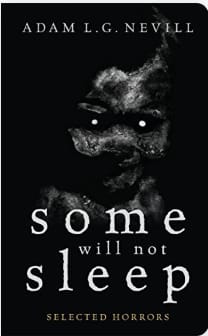
Mostly Good stuff in here. Mostly.
Depending on the collection, reviews may be just one or two books. Some reviews will duplicate, because collections are like that. I didn’t hit up any other stories in multi-author collections, but that ended up being okay because Nevill resubmitted work in multiple formats so anything he put out there was also in one of his own books.
Some Will Not Sleep
“Where the Angels Come In”: 3.5. The white mansion on the hill is to be avoided at all costs. Children and pets disappear all of the time. They definitely disappear if they go to the house, despite everyone having a story about how they went in and survived or brought home a creepy souvenir. Is it haunted? Vampires? Something else? Some typical pre-teen boys decide to violate boundaries and age-old wisdom for adventure, and find out exactly what lurks behind the walls of the town’s greatest mystery. Only one makes it out to tell the story. It’s not the most original story of the bunch– we all know that adolescents love to break the rules about “that house” and tend to be murderkilled— but it’s solid.
“The Original Occupant”: 4. Atterton, Berringer, and the narrator are old school chums, and Atterton has a habit of making poor decisions with money, women, and professions. It makes sense that Atterton makes the batshit insane choice to spend a year unplugging in the Swedish wilderness in a remote town with his only contact being hand-written letters. And, to be fair, the first couple of letters are fine. Then, they take a dark twist about what really lives on bad land in an isolated forest. This drives Berringer to the same location to find out what happened to his friend.
I really loved Dark Matter by Michelle Paver, so this story’s score probably benefited from the incredibly fond feelings I have for that book and its similarities in tone and storytelling methods. While it has similar themes and shenanigans as the Ritual— Nevill himself calls it the acorn for the later book— it’s a short story that works out a lot better because of the lack of split narratives. Also, I’ve learned never to live in a place where the day or night completely goes away. Going to stay well south of the Arctic Circle, thank you very much.“Mother’s Milk”: 3. Three parts The Hills Have Eyes, two parts fairy tale, and one part a story about the depths of addiction, our narrator took one sip of the fabled milk and became a prisoner of a family. They want to escape, if only they didn’t need the milk only Mother can provide. It’s less a story and more the capturing of a few days of need and how people end up in that situation.
“Yellow Teeth”: 4. This is dead-on Under a Watchful Eye. The narrator is a professional with a clean life and nice girlfriend until an old college-mate, Ewan, invades his space. Ewan becomes more disgusting as time continues, refusing to wash, clean, or anything else that involves keeping the space or himself up. He also won’t leave and writes about the requirements of his goddess. Then weird shite begins to happen, so maybe Ewan isn’t gross and crazy, just gross. Nearly the entire narrative occurs within the apartment, and the story is better than the book without the location shift to the creepy old estate. Again, I hate roommates and horror is other people.
“Pig Thing”: 3.5. A family moves to New Zealand, part of an immigration effort for a new life. What they don’t understand, having only lived in plastic and cardboard suburbs, is the bush is home to older families and even more ancient traditions that the new family can’t or won’t adhere to. After they see the Pig Thing, mom and dad hide their three children in the laundry room so the parents can investigate a monster. When they don’t return, the children make a plan, perhaps disastrous, to escape. There were some tonal similarities to Cunning Folk, given the nature of the Pig Thing and the conspiratorial nature of its existence. The ending is on point, even if a little expected.
“What God Hath Wrought”: 5. A soldier and a prospector meet. The prospector is just another man looking for gold. The soldier? He’s seeking a man and his followers, the man having claimed to have found an angel instead of the Books of Mormon in a cave. The Soldier contends if that angel is the patron of anything, it’s pestilence. He seeks to destroy the “nephites” the man and angel created from the towns they pass through, a group that includes his sister.
This probably wasn’t perfect, but in no way can you tell me that. Among this story, the Dark Tower series, Little Haven, and ¼ of Last Days (the Utah section), I am 150% more enthusiastic about the notes for my queer western horror novel.
One Bikket to rule them all.
Doll Hands”: 3.5. A night porter with congenital defects– translucent skin, a too large head and too small hands, is responsible for helping with a meal that will be served at a banquet for the elderly elite who live in the building. For rich people during the apocalypse, the meal includes human flesh. The porter’s involvement ends up snapping something deep within him, ensuring their antagonism toward their former employers is violent and bloody.
“To Forget and Be Forgotten”: 4. Again with the night porters, but in a slightly less apocalyptic world. Same old haunts and creepy elderly monsters though. A guy who just wants to be left alone to live his life is drawn into their shenanigans when the building proves unwilling just to let him be. This and the previous story tie together themes later seen in Apartment 16: the ancient inhabitants of an even older location and how that leads to supernatural levels of fucked. Nevill was a porter at one point, so he used his experiences to craft up some scares.
“The Ancestors”: 3.5. A young family moves to the countryside for the father’s health. Meanwhile, their young daughter makes an “imaginary” friend who wants to keep her forever, so it tortures the rest of the family with demonic toys made of knitting needle legs and body parts sewn into their clothes. And then it gets worse.
Nevill was inspired by early aughts J-horror according to his author notes and hits all the high points of long-haired ghosts and stop-gap puppetry. It reminds me quite a bit of House of Small Shadows with the possessed dolls. If this collection was a part of his earlier work, it makes sense that so many of these stories are the seeds of the novels he later wrote.“The Age of Entitlement”: 3. Our narrator has given up his life, spending the twenty years accompanying his friend to haunted locations, investigating potential energy created by traumas like wars or genocides. Not only has he accompanied this friend, but he played the doormat while the guy ate the last of his food, did the last of his drugs, took up the last of the space the narrator needed to be a person. Then, he finds out that this friend is rich, and has not only a mansion, but a fiancée waiting for him at home, All while the friend mooched off him in every possible way by playing the poor man. Resentment is a small word for what he feels. I really considered ranking this a bit lower, but I have to appreciate that I empathized with a man who had been pulled a million different directions by a person who only drained him of every tangible and intangible resource. We’ve all been there. We’ve all had this friend. We’ve all wanted to hurt them.
“Florrie”: 3. The narrator, long resigned to living with others, has bought the house of an elderly couple where the man has died and the woman is lost to dementia. He intends on renovating and creating the modern and minimalist home of his dreams. However, as his mother once told him, some houses have a history, a bad feeling about them, a type of haunted presence. This home is no different, as he begins to have odd experiences, ones that seem to be taking over his mind and body as he becomes someone else. Not the most novel of things, but decent